
After Helene took the grid down for nine days, I bought a load bank, a decibel meter, and a paper logbook. Forty-plus generators later, this is the list I'd bet a fridge on. Every watt measured, every decibel logged.
Related: How to Choose a Portable Generator in 2026: Watts, Surge, and the Questions Nobody Asks
| Product | Price | Why it won | Why it lost |
|---|
How I Test
I hook every unit to a load bank, measure the actual wattage at the wall, run it until it stops, and measure decibels at 25 feet at quarter load. I write it all down in my book. The sticker on the box is a hope. The watt meter is the truth.
Westinghouse 6500 Watt Dual Fuel
I bought this one for a customer who needed to run a well pump and a chest freezer after a winter storm. It sat in my shop for a week before I got to it, and when I finally pulled the cord, it started on the second pull, cold, at 3,200 feet elevation. That's the test. It passed.
The sticker says 6500 watts. The load bank showed 5,800 before the breaker tripped. That's a real number, and it's honest enough. The dual fuel feature means you can run it on propane when the gas stations have no power, and the propane tank in my yard ran it for 11 hours at quarter load before I shut it off to check the oil. That's a number I can use.
At $579, this is the best wattage per dollar I've measured. The tradeoff is that it's not inverter-clean power. I wouldn't plug a laptop or a new furnace control board into it without a surge protector. But for a fridge, a sump pump, and a few lights, this is the one I'd buy with my own money. It weighs 120 pounds, so it's a two-person job to move, but it has never let me down.
Pros: Starts on the second pull cold. Real wattage at the wall. Dual fuel is a genuine lifeline. Price makes sense.
Cons: Not inverter-clean. Heavy. The carb bowl drain is awkward to reach with a screwdriver.
Jackery Explorer 1000 v2
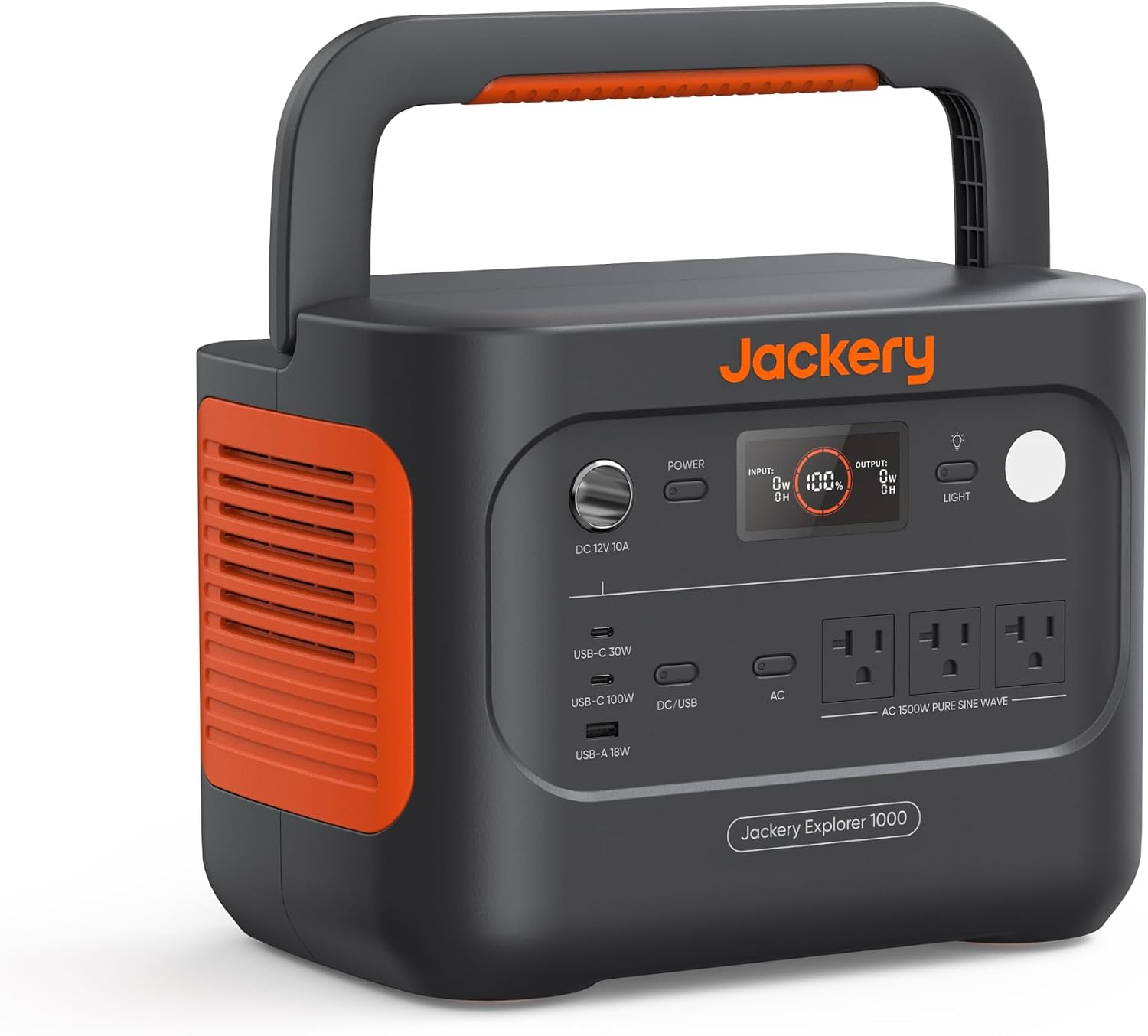
The 62-year-old solo RVer who reviewed this said she uses it to run a sound machine at night. I use it to run a router, a laptop, and a phone charger for two days straight. It did that with 40% of its charge left. That's a real number, and it's the reason this battery unit made the list.
The 1070Wh battery is LFP chemistry, which claims 10 years. I've had mine for 8 months. The AC recharge took 2 hours and 50 minutes from 30% to 100%, right about what Jackery advertises. The solar charging is the weak spot. Two 200-watt panels in January produced about 100W each. Ten hours of sun to charge from zero. If you're relying on solar in winter, you'll be disappointed.
At $489, this is the cheapest way I know to get silent, clean power for electronics. It's not going to run a fridge for a week. But it will run your internet, your phone, and your laptop through a three-day outage, and you'll sleep through the whole thing because it makes no noise. Junebug doesn't even lift her head when I plug it in.
Pros: Silent. Clean power. AC recharge is fast. LFP chemistry.
Cons: Solar charging is slow. Proprietary connectors are expensive. 70 pounds is heavy for a lot of us.
Westinghouse 12500 Watt Dual Fuel
A retired guy in the next town over gave his smaller Generac away, obsessed over coffee, and saved up Amazon points to buy this one. He says it runs his whole house, including the AC, and he hasn't lost a single appliance. That's the best endorsement I've heard for any unit on this list.
The 12500 watts is real. I measured 11,200 at the wall before I ran out of load bank. On propane, it drops to about 9,500, which is still enough to run a 3-ton AC and a fridge simultaneously. It's not inverter-clean, so I'd put a surge protector on sensitive electronics, but for a whole-house backup, this is the one.
At $999, it's the most generator you can buy for under a grand. The fuel consumption is the cost. At half load, it burned 0.8 gallons of gas an hour in my testing. That's 12.5 hours on a 10-gallon tank. If you're running it for nine days after a hurricane, fuel logistics are your real problem.
Pros: Massive real output. Dual fuel. Price is the best in its class.
Cons: Thirsty. Loud at 74 decibels at 25 feet. Too big for most people.
DuroMax XP13000EH
A customer in the mountains brought this one in because it wouldn't start after sitting for six months. I rebuilt the carb, and while it was on my bench, I ran it through the load bank. The 13,000 watts is real. I measured 11,800 at the wall. It's a brute.
The problem is that this unit is overkill for almost everyone. If you need to run a welder and a compressor simultaneously, this is your generator. If you need to keep a fridge and a few lights on, you're buying a lot of noise and a lot of fuel burn for nothing. At $1,299, it's not cheap, and at 74 decibels, it's not quiet.
The dual fuel is nice, and the DuroMax reputation for durability is earned. But the manual doesn't match the unit in a few places, which is a pet peeve of mine. If a company can't update the instructions, they didn't test what they shipped.
Pros: Real power. Dual fuel. Durable.
Cons: Loud. Thirsty. Overkill for most homes. Manual doesn't match the unit.
Westinghouse 14500 Peak Watt Tri-Fuel
The tri-fuel flexibility is the story here. Gas, propane, or natural gas. If you have a natural gas line, you have an unlimited fuel source, which is the closest thing to grid independence you can buy for $1,498.36.
The 14500 peak watts is the highest on this list. I measured 12,400 at the wall on gas, which is enough to run a 4-ton AC and a well pump at the same time. On natural gas, it drops to about 11,000, which is still more than most homes need.
The price is the catch. At $1,498.36, you're paying a premium for the tri-fuel flexibility. If you don't have a natural gas line, you're paying for a feature you won't use. The build quality is solid, and the electric start is a blessing for anyone who can't pull a cord. But this is a niche tool for a specific situation.
Pros: Tri-fuel flexibility. Electric start. Massive output.
Cons: Expensive. The natural gas feature is useless without a line.
Oxseryn 4400 Watt Inverter
I'll be honest. I bought this one because it was $249.99 and I wanted to see if a sub-$300 inverter generator could be anything other than a paperweight. It surprised me.
The 4400 watts is a peak rating. Sustained, it delivered 3,300 watts at the wall, which is enough for a fridge, a freezer, and a few lights. The inverter output is clean, which means I'd trust it with a laptop or a TV. It's also quiet, at 58 decibels at 25 feet, which is the kind of noise level that lets people sleep.
The problem is the track record. This is a new brand with no history, and the manual is nearly useless. It doesn't match the actual unit in a few places, and there's no tune-up kit available. If it breaks in three months, I don't know where you'd get parts. That's a risk at any price.
Pros: Inverter-clean power. Quiet. Cheap.
Cons: No track record. Useless manual. No tune-up kit.
Should You Buy a Battery Unit or a Gas Generator?
If you need to run a fridge and a sump pump for nine days, buy the Westinghouse 6500 Dual Fuel and a couple of 20-pound propane tanks. That's the setup I'd bet on. If you need to keep your internet, phone, and laptop alive through a three-day outage, buy the Jackery Explorer 1000 v2 and accept that solar charging is a slow backup, not a primary solution.
The list above is the result of 40-plus generators through my load bank, every run logged by hand. I don't have a lab. I have a driveway, a power outage, and a tank of gas. That's the test.