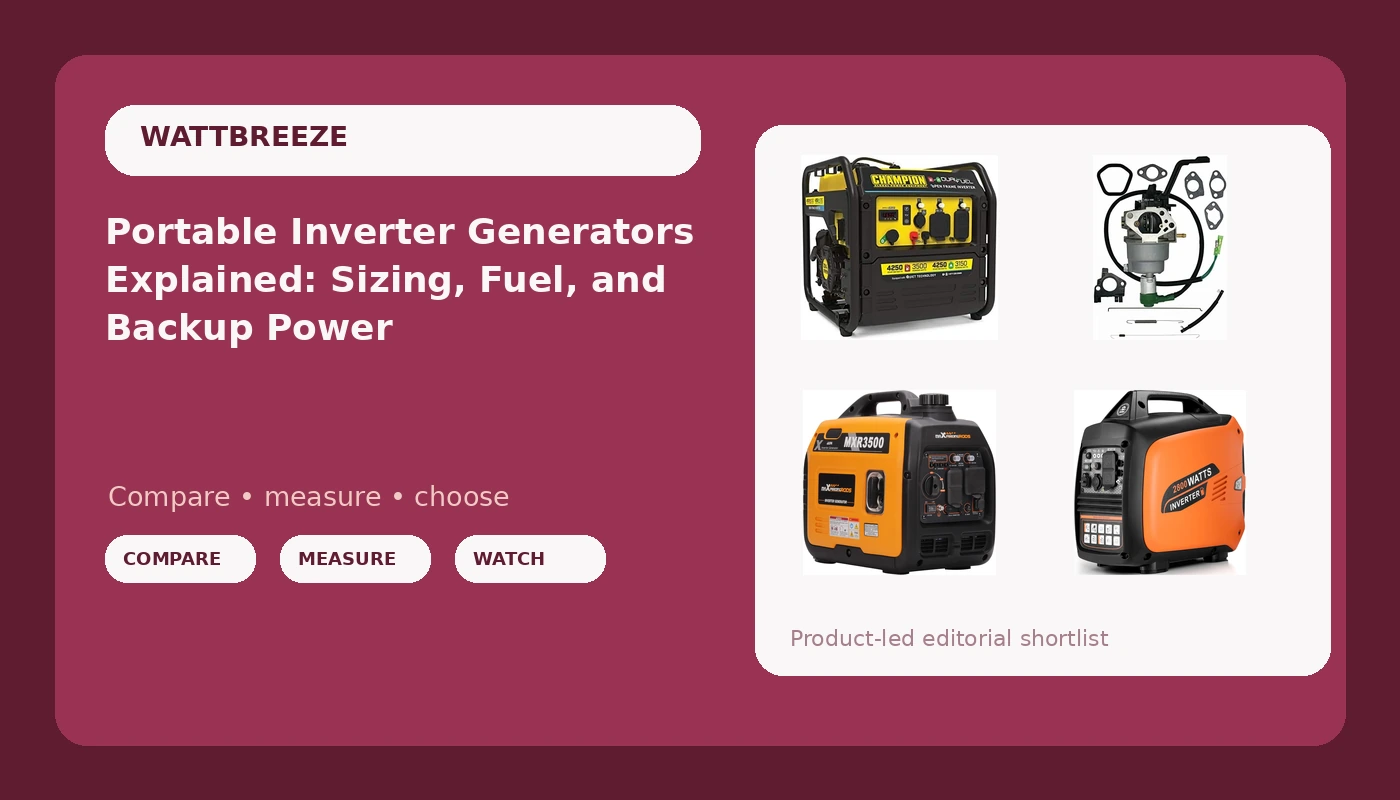
Portable inverter generators sit in an odd spot in the market. They cost more per watt than the open-frame contractor units, they weigh less, they produce cleaner power, and they are the only category most households should be looking at if anyone within earshot is trying to sleep. The trouble is that the spec sheet is written to sell rather than to inform. Peak watts get the big type, running watts hide in the fine print, and run time gets quoted at a load almost nobody runs. This guide walks through what those numbers actually mean, how the four options below differ from each other, and which one fits a fridge and a sump pump, a camper, or a jobsite.
Related: How to Size a Generator for a Fridge, a Sump Pump, and a Furnace →
Quick answer
Inverter generators are worth the premium when you need clean power for electronics and quieter operation near people, and a conventional open-frame unit is cheaper per watt when neither of those things matters to you. To size one, add up the running watts of everything you want on at the same time, then add the largest motor's surge, which is typically two to three times its running watts. Fuel type, weight, and whether the unit can run on propane often decide the purchase more than the watt rating does. Do not label a product the quietest, fastest, safest, or best unless the available evidence supports that distinction.
Four useful options
| Model | Best fit | What stands out |
|---|---|---|
| Champion Power Equipment 4250-Watt Dual Fuel RV Ready Portable Open Frame Inverter Generator with Quiet Technology | Household basics and RV use where either gasoline or propane is on hand | A 4,250-watt rating combined with dual fuel capability in an inverter design |
| Oxseryn 2800-Watts Portable Inverter Generator | Small backup loads, camping, and one-person carrying | 39-pound weight, 1.1-gallon fuel tank, and a fuel shut off valve |
| MaXpeedingrods 3500 Watt Portable Inverter Generator | Mid-size gasoline backup and jobsite power | A 3,500-watt rating in a gasoline-only inverter package that is EPA compliant |
| YAMAKATO Huayi P27-1D Gasoline Generator Carburetor | Bringing a carbureted Champion or Predator unit back to life | A replacement carburetor listed for Champion and Predator gasoline generators |
The dual-fuel all-rounder: Champion Power Equipment 4250-Watt Dual Fuel RV Ready Portable Open Frame Inverter Generator with Quiet Technology
Dual fuel is the feature people underestimate until they need it. Gasoline goes stale and the stations close during a wide outage, but a propane tank can sit for years and a grill tank is often already in the garage. Propane also tends to burn cleaner, which is easier on a carburetor that may sit for months between runs. The trade-off is output: most dual fuel units make less power on propane than on gasoline, so the watt rating on the box is not the number you get on the bottle. The open frame design also means more exposed engine noise than a fully enclosed suitcase unit, which matters if the neighbors are close.
The lightweight pick: Oxseryn 2800-Watts Portable Inverter Generator
The fuel shut off valve is a small detail that pays off over a season. Closing it and letting the engine run the bowl dry before storage is the simplest defense against ethanol fuel turning into varnish inside the carburetor. Small tanks cut both ways: 1.1 gallons is easy to pour and easy to store, but it also means more refueling stops during a long outage. Plan on roughly a gallon per several hours of moderate load and keep a spare can. The 2,800-watt rating covers a refrigerator, lights, a router, and a phone charger at the same time, but it is not the unit to buy if you want a window air conditioner and a sump pump running together.
The mid-size gasoline pick: MaXpeedingrods 3500 Watt Portable Inverter Generator
The extra 700 watts over the compact unit is the difference between running a fridge and a sump pump on separate shifts and running them together, provided you stagger the motor starts. Gasoline only means one fuel to store, one can to rotate, and one set of numbers to remember, but it also means no fallback if the gas stations are dry. For a jobsite where a circular saw and a compressor share the load, this class of machine is the practical middle ground: enough headroom to start a motor without tripping, without the weight of a full open-frame conventional unit.
The maintenance part: YAMAKATO Huayi P27-1D Gasoline Generator Carburetor
A carburetor is not magic, it is math and patience, and most of the failures blamed on a carburetor start with fuel left sitting in it. Before buying a replacement, confirm the part number on your existing carburetor and your engine's model and serial information, because "for Champion Predator" covers a range of units and not every one uses the same pattern. If the engine will not idle or surges under load, cleaning the existing carburetor is usually the first move and replacement is the second. Keep in mind that a new carburetor will not fix a unit with no spark or low compression, so diagnose before you order.
Prices and availability may change. Product images, names, and retailer links must be matched by verified ASIN. Do not state a current price, rating, stock status, or measured result without current evidence.
Running watts and surge watts: the only two numbers that matter
Every motor in your house has two power figures. Running watts are what it draws continuously, hour after hour. Surge watts, sometimes called starting watts, are the brief spike the motor needs to get moving, and that spike is usually two to three times the running figure. A refrigerator might run at a few hundred watts and spike well past a thousand for a second or two when the compressor kicks in. A sump pump behaves the same way.
This is why a generator that handles a space heater without complaint can still stumble on a fridge. Resistive loads like heaters and incandescent bulbs draw a steady, predictable amount. Motor loads draw a spike that the generator has to absorb without dropping voltage far enough to stall the motor or trip its own breaker. Add the running watts of everything you want on at once, then add the surge of the single largest motor, and size from that total. If two big motors need to start close together, either stagger them or move up a size class.
Inverter generators matter here for a second reason: power quality. Total harmonic distortion, or THD, describes how clean the sine wave is. Under 5% is the threshold most people use for laptops, televisions, and modern appliances with circuit boards. Inverter units produce that clean output; inexpensive conventional generators generally do not.
Dual fuel, gasoline, and what actually changes
Fuel choice shapes the whole ownership experience. Gasoline is easy to find and delivers full rated output, but it degrades. Ethanol blends absorb water and turn to varnish in a carburetor within months, which is why stabilizer and a shut off valve matter more than most buyers expect. Propane stores almost indefinitely, burns cleaner, and does not gum up a fuel system, but a dual fuel generator generally makes less power on propane than on gasoline, and you need to keep tanks on hand.
Weight and noise follow from all of this. A 39-pound unit can go in a car trunk; a 4,250-watt open-frame machine wants wheels and a flat path. Noise should be judged at a real distance under a real load, not by the word on the box, because sound falls off with distance and rises with engine speed. If the generator will run near a bedroom window, that difference is the purchase decision.
- List every load you want powered at the same time, and note the running watts of each.
- Add those running watts together to get your baseline.
- Identify the largest motor on the list and add its surge, typically two to three times its running watts.
- Decide which fuel you can actually store and resupply during an outage.
- Check the weight and the noise rating against who has to move it and who has to sleep near it.
Practical guidance before you buy
- Use ethanol-free fuel, or at minimum add stabilizer and run the carburetor dry before storage.
- Change the oil on the schedule in the manual, and check it before every long outage run.
- Exercise the generator under a real load every month or two so you are not learning its quirks at 2 a.m.
- Keep a carbon monoxide detector in the living space and never run a generator in a garage, even with the door open.
- Match extension cord gauge to distance and load; a long thin cord wastes power as heat and can starve a motor.
Which option should you choose?
Choose the Champion Power Equipment 4250-Watt Dual Fuel RV Ready Portable Open Frame Inverter Generator with Quiet Technology when you want the most output here and the option to run on propane as well as gasoline, and you have wheels or a helper for the weight. Choose the Oxseryn 2800-Watts Portable Inverter Generator when the priority is a 39-pound unit you can lift into a truck bed or a closet and the load list is small. Choose the MaXpeedingrods 3500 Watt Portable Inverter Generator when you want more headroom than the compact class for a gasoline-only setup. Choose the YAMAKATO Huayi P27-1D Gasoline Generator Carburetor when the generator you already own has a fuel problem and the part number matches.
The caveat is fit and evidence. Watt ratings, tank sizes, and weights come from manufacturer listings, and a listing is not a load test. Verify the outlet configuration, the running versus surge rating, and the carburetor part number against your own equipment before you commit, and treat any quiet or run time claim as a starting point to check rather than a settled fact.
The bottom line
Portable inverter generators are a clean-power and low-noise purchase more than a raw-wattage purchase, and the right size depends on the surge your largest motor demands, not the number in the biggest font on the box. Match fuel type to what you can realistically store, match weight to who has to carry it, and match the part to the machine you already own. Do that math first and the choice between these four stops being a guess.