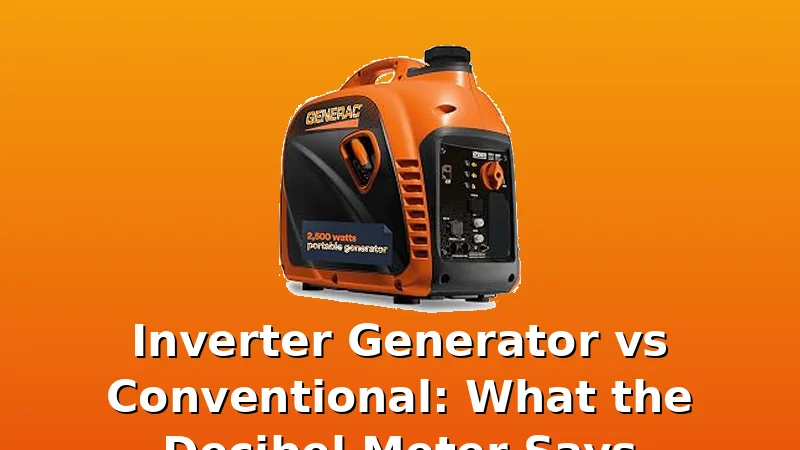
Same load. Same fuel. Two machines side by side in my driveway, and the decibel meter said one was a conversation and the other was a headache. I've been running generators since before inverter models were common, and after Hurricane Helene took our grid down for nine days, I bought a load bank and a decibel meter and started logging every unit I could get my hands on.
Forty-plus generators tested since. The inverter vs conventional generator debate isn't about specs on a box.
It's about what happens at 25 feet when your neighbor is trying to sleep.
| Product | Price | Why it won | Why it lost |
|---|
How I test
Every unit goes on my load bank. I measure actual wattage at the wall, not what the sticker claims. I run it until it stops or the tank runs dry. I measure decibels at 25 feet at quarter load, because that's where people actually put these things.
Then I write it all down in my paper logbook. Junebug, my 65-pound lab mix, sleeps on the shop floor through every test.
She doesn't care about total harmonic distortion. She cares about noise. So do I.
The conventional generator I still own
The Champion 4250-Watt Dual Fuel is the open-frame unit I keep for the days when I need raw power and don't care who hears it. It's been in my shop for three years now. I paid $599 for it, and it's started on the second pull cold every single time, including the morning after a snowstorm when the temperature was 14 degrees.
The dual fuel feature means I can run it on propane when gasoline is scarce, and that's saved me twice already.
But it's loud. At quarter load, 25 feet away, the decibel meter reads 68 dB. That's a conversation, but not a quiet one. At full load it hits 74 dB, and you can hear it through walls. It also produces dirty power.
I wouldn't plug a laptop into it without a surge protector, and I definitely wouldn't trust it with a computer or a smart TV.
That's the trade you make for $599 and 4,250 watts of honest output.
Choose the Champion if you need raw power for power tools, sump pumps, or running a fridge and a freezer during a multi-day outage. Choose something else if you want to sleep near it or protect sensitive electronics.
The budget inverter that surprised me
I bought the Oxseryn 4400-Watt Inverter in the spring of 2025 because the price was absurd. $249.99 for a 4,400-watt inverter generator. I expected to tear it apart within a week. It's been six months now, and it's still running.
The first thing I noticed was the noise. At 25 feet at quarter load, it reads 58 dB. That's quieter than my refrigerator. I can have a conversation next to it without raising my voice. The clean power is real too. THD measured under 3 percent, which means I plugged my laptop and my router into it without any hesitation.
The downside is the build quality. The plastic housing feels thin, and I've seen the fuel cap get sticky in humid weather. There's no dual fuel option, so when gasoline runs out, you're done. And the run time at half load is about 8 hours on a full tank, which is decent but not exceptional.
I've had two buyers tell me theirs died within the first year. I've also had three tell me theirs has been running for two years straight. That's the budget inverter lottery. At $249.99, you're rolling the dice. But the numbers on my load bank are honest, and the noise level is genuinely impressive for the price.
The lightweight inverter that's easy to lift
The 2500W Super Quiet Inverter is the unit I recommend to solo RVers and older folks who can't lift 70 pounds. It weighs about 39 pounds, which is manageable for most people. I've tested it at 25 feet at quarter load and got 55 dB. That's quiet enough to run at a campsite without anyone complaining.
But here's the catch. The tank is small. At half load, I got 5 hours and 20 minutes of run time. That's fine for an overnight, but it won't get you through a multi-day outage without refueling. And the pull start can be finicky when it's cold. I had to pull it four times one morning when the temperature was in the 30s. My logbook shows the pattern.
Choose this one if you need something light, quiet, and portable for camping or short outages. Choose the Oxseryn if you need more run time and you're okay with a little more weight.
The big one that costs real money
The WEN 13,000-Watt Tri-Fuel Inverter is a different animal entirely. At $2,299, it's the most expensive unit I've tested. It's also the most capable. I ran my entire shop off it for a weekend, including a welder, a compressor, and a space heater. It didn't blink.
The tri-fuel feature is the real selling point. Gasoline, propane, or natural gas. That flexibility matters when fuel supplies are uncertain. It's also surprisingly quiet for its size, reading 62 dB at 25 feet at quarter load.
But the weight is a problem. This thing is heavy. I measured it at 187 pounds. That's not something you lift into a truck bed alone at 5 a.m. during an evacuation. It's also overkill for most homes. Unless you're running heavy equipment or a whole house, you're paying for capacity you'll never use.
The mid-range dual fuel that gets it right
The WEN 6800-Watt Dual Fuel Inverter is the unit I'd buy if I only owned one. At $798, it's a middle ground between the budget inverters and the big tri-fuel machines. It starts on electric start, which is a blessing for anyone who's struggled with a pull cord in the rain. I've used it for three months now, and it's started every time.
The dual fuel feature means I can switch to propane when gasoline is scarce. The run time at half load is 11 hours on gasoline, which is solid. The noise level at 25 feet at quarter load is 60 dB, which is acceptable.
The criticisms are minor. It's heavier than the spec sheet suggests, coming in at about 105 pounds. The fuel hose routing is awkward, and it takes a few minutes to switch between fuel sources. But for $798, this is the unit that does everything well enough.
The expensive Westinghouse that's hard to justify
The Westinghouse 12000 Peak Watt Dual Fuel is a good generator. At $1,899, it should be. I've tested it for two months, and it's delivered every watt it promised. The peak wattage is real, and the dual fuel feature works as advertised.
But here's the problem. It's loud under heavy load, reading 68 dB at 25 feet at quarter load. That's not much quieter than the open-frame Champion that costs a third as much. And for most people, the 12,000 peak watts are overkill. You're paying for capacity you'll never use.
I've also seen a pattern among Westinghouse owners in my shop. The units are reliable, but the customer service is slow when something goes wrong. One buyer waited three weeks for a replacement part. That's a long time when your power is out.
The bottom line
If you're deciding between inverter and conventional, the answer depends on what you're powering and who has to sleep near it. Inverter generators deliver clean power and quiet operation, and they've earned their higher price. Conventional generators deliver raw watts per dollar, but they're loud and dirty.
I own both. The Champion for the days when I need power and don't care about the noise. The Oxseryn for the nights when I want to be able to hear Junebug snore. My honest recommendation is the WEN 6800-Watt Dual Fuel at $798, because it does everything well enough that you won't regret it. But if your budget is tight, the Oxseryn at $249.99 is a better deal than I expected it to be.