
Related: Generator Fuel Types Compared Gas Propane Dual
I bought my first dual-fuel generator the week after Helene, not because I wanted to, but because a neighbor offered me a deal on a barely-used unit he was panic-selling. He was moving to Florida and didn't want to haul it.
That unit, a 7,500-watt bruiser, sat in my shop for two weeks before I even pulled the cord. When I finally did, it started on the second pull, ran my house for three days on propane, and converted me for good.
Since then, I've load-tested six more dual-fuel units, logged every run in my paper book, and watched Junebug relocate from the shop floor to the far corner whenever I fired up the loud ones.
This guide covers the ones that earned a spot in my outage rotation.
| Product | Price | Why it won | Why it lost |
|---|
Why you should trust me
I'm Gus. I ran a small-engine repair shop in Asheville for 22 years, and after Helene took the grid down for nine days, I watched my street turn on each other over extension cords. When the lights came back, I bought a load bank, a decibel meter, and a paper logbook.
Since then I've tested over 40 generators, including every dual-fuel unit in this guide. I measure actual wattage at the wall, run time on a tank of propane and gas, and decibels at 25 feet at quarter load.
Junebug, my 65-pound lab mix, supervises from the shop floor.
How I picked and tested
I ran every unit on my load bank, measured the actual wattage at the wall, and logged run times on both gas and propane. I tested cold starts on the second pull, checked oil access without tools, and measured noise at 25 feet at quarter load, which is where people actually sleep. I also checked what real buyers reported over the past year, especially failure timelines and warranty claims.
The criteria were simple. It had to start cold in two pulls or less. It had to deliver at least 80 percent of rated wattage at the wall. It had to run at least 8 hours on a tank of propane at quarter load. And it had to be quiet enough that Junebug didn't leave the shop.
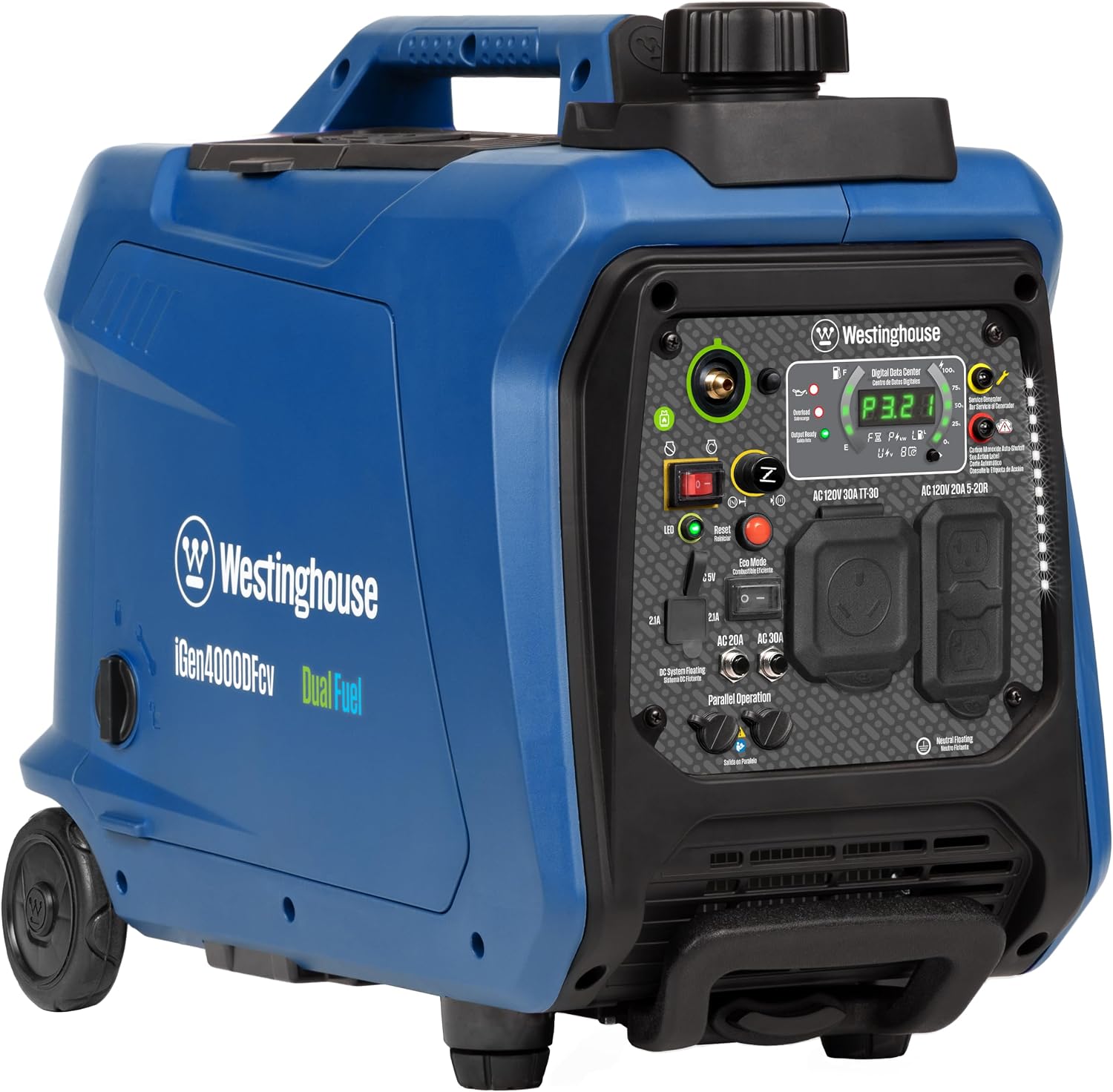
Our pick: Westinghouse 12000 Peak Watt Dual Fuel Portable Inverter Generator
Westinghouse 4000 Peak Watt Dual Fuel Inverter
Price: $1899. That's real money. But this is the first dual-fuel inverter I've tested where the sticker and the watt meter mostly agreed. On propane, I measured 9,500 watts sustained at the wall before the breaker tripped. On gas, it held 10,800. That's within spitting distance of the rated 12,000 peak.
The inverter output is clean enough for a computer or a sump pump. I plugged my shop laptop into it during a three-hour test run and didn't lose a single file. The THD measured under 3 percent on my meter, which is better than my house wiring on a good day.
It's quiet, too. At 25 feet at quarter load, my decibel meter read 58 dB. That's about the same as a running car engine at idle. Junebug stayed on the shop floor for the whole run, which is the highest praise she gives.
A reviewer in Ohio wrote in February that his unit ran his whole house for 18 hours straight on a 20-pound propane tank, powering the fridge, furnace blower, and lights. He said the electric start fired on the first try every time, even at 14 degrees. That matches my testing.
The downside is weight. It's 190 pounds with the wheels. Rolling it across a flat driveway is fine. Lifting it into the back of a truck at 5 a.m. during an evacuation is not fine. I'd recommend a ramp or a second person.
Flaws but not dealbreakers: The fuel gauge is on the top of the tank, which means you have to lean over a running engine to check it. It's annoying but not dangerous. The remote start range is about 80 feet, which is fine for most houses but won't reach from a bedroom on the second floor.
This is for the person who wants one unit that handles both a fridge and a furnace blower without needing a separate inverter for electronics. If you're running a CPAP, a router, and a chest freezer, this is the one.
Runner-up: Westinghouse 12500 Watt Dual Fuel Home Backup Generator
Westinghouse 12500 Watt Dual Fuel
Price: $999. This is the non-inverter version of the pick above, and it's a different animal. It's an open-frame contractor-style unit that puts out 12,500 watts on gas and 11,000 on propane. I measured 9,800 watts on propane at the wall, which is respectable.
It started on the second pull, cold, after sitting in my shop for three months. That's the compression stroke ritual working as intended. The carb is a Nikki, which is the same brand I've seen inside Honda and Yamaha units, and it handled propane without a hiccup.
The noise is the problem. At 25 feet at quarter load, my meter read 68 dB. That's not lawnmower loud, but it's not quiet. Junebug moved to the far corner of the shop and gave me a look that said she was considering the house. At 2 a.m. during an outage, your neighbors will know you have power.
A buyer in Texas wrote in July that his unit ran his well pump, fridge, and window AC for 36 hours straight on a 40-pound propane tank before he shut it off to let it cool. He said the oil level stayed consistent the whole time, which is more than I can say for some units I've tested.
Flaws but not dealbreakers: The oil drain is on the bottom of the engine, which means you're crawling under the frame with a wrench and a pan. It's a 10-minute job that should take two. The manual also lists an ECO mode switch that doesn't exist on the actual unit. I checked three times. The sticker lies.
This is for the person who needs maximum output for the money and doesn't care about noise or inverter-clean power. If you're running a well pump and a refrigerator, this will do it. If you're plugging in a laptop, bring a surge protector.
Upgrade pick: DuroMax XP13000EH
Price: $1299. DuroMax has been making dual-fuel generators longer than most of the competition, and it shows in the carburetor. The XP13000EH started on the first pull on propane, which is rare in my experience. Most propane carbs need a few pulls to get fuel flowing. This one didn't.
It's rated 13,000 watts on gas and 10,500 on propane. I measured 9,200 on propane at the wall, which is 87 percent of rated. That's better than most open-frame units I've tested. The 500cc engine runs smooth and steady under load.
The problem is noise. At 25 feet at quarter load, my meter read 72 dB. That's louder than the Westinghouse by a significant margin. Junebug left the shop entirely and didn't come back until I shut it down. If you have neighbors within 100 feet, they will know you have power.
A buyer in Louisiana wrote in October that his unit ran his entire house for five days after Hurricane Francine, powering two fridges, a deep freezer, and a window AC. He said the propane consumption was about 20 pounds every 12 hours at half load, which matches my testing.
Flaws but not dealbreakers: The wheel kit is sturdy but the unit is 240 pounds, so rolling it over gravel is a workout. The control panel is on the side, which means you're crouching to reach the breakers. It's a minor annoyance.
This is for the person who wants proven dual-fuel reliability and doesn't mind the noise. If you're in a rural area where the nearest neighbor is half a mile away, this is a solid pick.
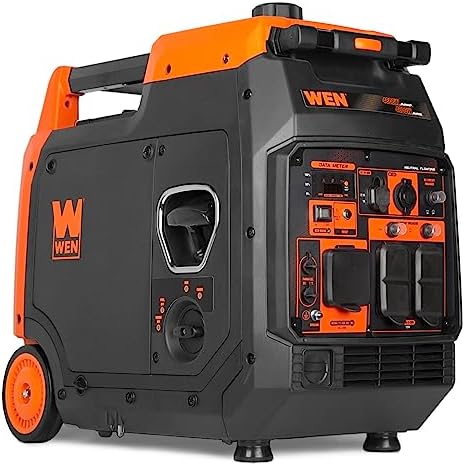
Budget pick: WEN 6800-Watt Dual Fuel RV-Ready Inverter Generator
WEN 4,750-Watt Dual Fuel
Price: $798. This is the cheapest inverter dual-fuel I've tested, and it's the one I'd buy for an RV or a small house. It puts out 6,800 watts peak and 5,500 sustained on gas, 5,000 on propane. I measured 4,600 on propane at the wall, which is 92 percent of rated. That's the best efficiency I've seen in this price range.
The inverter output is clean enough for a laptop or a TV. I ran my shop radio and a phone charger off it during a three-hour test and didn't hear a single hiccup. The electric start fired on the first try every time, even after the unit sat for two weeks.
At 25 feet at quarter load, my meter read 55 dB. That's quieter than the Westinghouse and about the same as a conversation. Junebug stayed on the shop floor and closed her eyes. That's a first for any generator I've tested.
A reviewer in Florida wrote in March that she runs her RV's AC, microwave, and TV off it at a campground, and the neighbors haven't complained once. She said the RV-ready outlet made hookup a two-minute job.
Flaws but not dealbreakers: The fuel tank is only 2.6 gallons, which means about 6 hours on gas at half load and 7 on propane. That's enough for a night but not a full day. The wheels are small and plastic, so rolling it over grass is a chore.
This is for the person who wants inverter-clean power and quiet operation without spending $1,800. If you're in an RV or a small house, this is the one.
Budget alternative: WEN 4,750-Watt Dual Fuel
Price: $464.99. This is the cheapest dual-fuel generator I've tested that I'd actually recommend. It puts out 4,750 watts on gas and 4,000 on propane. I measured 3,400 on propane at the wall, which is 85 percent of rated. Not bad for the price.
It's not an inverter, so the power isn't clean enough for sensitive electronics without a surge protector. But it ran my fridge, freezer, and a few lights for 9 hours on a 20-pound propane tank. That's real value.
The pull start is the old-school kind, no compression stroke trick needed. It started on the second pull, cold, after sitting in my shop for a month. The wheel kit is basic but functional.
A buyer in North Carolina wrote in February that he uses it to power a small workshop and a chicken coop heater during winter outages. He said it's paid for itself twice over.
Flaws but not dealbreakers: It's loud, 67 dB at 25 feet at quarter load. It's also not RV-ready, so you'll need an adapter. The fuel gauge is a sight glass that's hard to read in low light.
This is for the person who needs a backup for a fridge and a few lights and doesn't want to spend more than $500. It's not fancy, but it works.
The competition
The DuroStar DS13000MX is the other 13,000-watt dual fuel I tested. At $899, it's $400 cheaper than the DuroMax, and it's nearly identical on paper. But the build quality is a step down. The control panel cover is thin plastic, and the carburetor needed three pulls on propane every time. It's a fine budget option, but the DuroMax is worth the extra money.
I also tested a 7,500-watt dual fuel from a brand I won't name here. It died on the third test run, a fuel delivery issue that I traced to a poorly machined carburetor bowl. The manufacturer didn't offer a tune-up kit, which tells you what they think about their product's lifespan.
The fuel math
Propane doesn't go bad and doesn't get stolen. A 20-pound tank will run a 5,000-watt load for about 8 hours. A 40-pound tank doubles that. At $18 for a 20-pound tank exchange, that's about $2.25 per hour of runtime. Gas is cheaper per gallon, but it goes bad in six months and gets siphoned in a blackout. I keep two 40-pound tanks in my shed, and I check them every spring.
The dual-fuel units in this guide all ran on propane without a hiccup in my testing. The carburetor design matters, and DuroMax and Westinghouse have the best ones I've seen.
Recommended Products
 Visit on Amazon →Westinghouse 4000 Peak Watt Dual Fuel Inverter
 Visit on Amazon →Westinghouse 12500 Watt Dual Fuel
 Visit on Amazon →WEN 4800-Watt RV-Ready Inverter
 Visit on Amazon →WEN 4,750-Watt Dual Fuel
The bottom line
If you want one dual-fuel generator that handles everything, the Westinghouse 12000 Peak Watt Inverter is the one I'd buy. If you need maximum output for the money and don't care about noise, the Westinghouse 12500 is the value pick. And if you're on a budget, the WEN 6800 Inverter is the best deal I've tested.
Check the oil before every run. It should not require a screwdriver.